Daybooks Report


Daybooks
The Daybook option is used to view the transaction activity for all or a range suppliers for a specified range of dates. From this option you can also print, preview, email and export to PDF the associated daybook reports. The Daybook option also gives you several options related to working with transactions including amending and undoing transactions and more.
You can access the Daybook report by selecting Reports > Supplier > Daybooks from the main menu or by selecting Daybooks from the Reports button in the Supplier section.
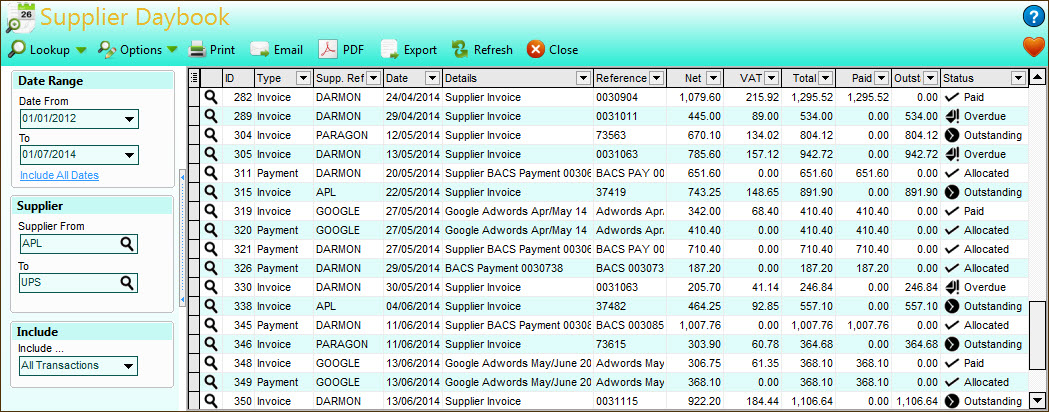
On the left hand side of the transactions list you have the range panel which is common to all reporting options in Avanti. This is where you specify the criteria for the transactions you want to include in the list and report. When you have defined the criteria you want you can hide this panel to expand the width of the transaction list by clicking the split-panel bar displayed between the range panel and the transaction list. You can click the split-panel bar again to show the range panel.
Date Range
Select the range of dates that you want to include transactions. The Date From box defaults to the Start Date For Report Range setting in Company Preferences. The Date To box will always default to today's date (or the date you sign-in to the software with). All transactions dated outside this date range will be excluded. Use the drop-down buttons at the side of the date boxes to select a date from a pop-up calendar.
If you don't want to set criteria based on a date range you can click the Include All Dates link under the date boxes. This will refresh the transaction list to disregard any consideration for dates. This is useful if you want to locate a transaction which is not listed using a date range as it may have been entered on a date outside the standard date range settings. After clicking the Include All Dates you can return to using a date range by clicking the Use Date Range link.
Supplier
Select the range of suppliers you want include transactions for. The supplier range settings are always defaulted to the first and last supplier references. Use the Look-Up icon (magnifying glass) in each box to find the supplier you want.
Include
The Include option is very useful to filter the list of transactions by a certain type of transaction. For example if you just wanted to see invoices or payments etc, Click the drop-down arrow for the Include ... box to see all of the options available and select accordingly. As you select to filter the transaction list by a specific type of transaction, totals are displayed at the bottom of the transaction list providing totals for the selected transactions in the list.
Toolbar
The Toolbar provides several buttons which are used to carry out key tasks :
Lookup
The Lookup button is used to drill into specific information about the currently selected transaction in the list. The button is actually split into two parts, if you click the left-part of the button you will be taken to the default lookup option for the transaction. If you click on the arrow part of the button to the right you will be given a menu of the drill-down options you have available.

Transaction Details
Provides a lookup window displaying the basic details of the transaction. For non-document based transactions this is the default drill-down option.
Journal Entries
Provides a lookup window displaying the journals recorded for the transaction enabling you to see a full breakdown of which financial accounts the transaction was recorded against.
Original Document
If the transaction was entered as a full sales or purchase invoice document then this option will display a window giving you all of the information about the original document including the stock items/products used, quantities, prices etc. For document based transactions this is the default drill-down option.
Payment Allocations
Displays a lookup window showing you the entries that the selected transaction is allocated against. For example if looking up a payment transaction this will show a list of invoices that it was paid against or if looking up an invoice it will show the payment that was used to pay it.
VAT Breakdown
Displays a lookup window showing a breakdown of values by VAT rate on the selected transaction.
Options
The Options button provides a drop-down menu containing additional tasks that may be carried out on a selected transaction.
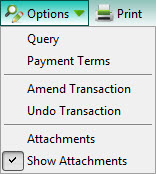
Query Transaction
This option is used to place an On-Query marker on the selected transaction and/or to enter notes about the transaction. Putting a query marker on a transaction will set it's status as On Query for enquiries and reports. See the Query Transactions page for more information.
Payment Terms
This options is used to alter the payment terms of the selected transaction. By default all invoices raised for a supplier have their standard payment terms recorded however if you need to adjust the terms for a specific transaction then you can do this here. See the Amending Payment Terms page for more information.
Amend Transaction
This option is very useful when you need to make changes and corrections on an existing transaction. When you select this option the software will check if there are considerations you should be aware of before you proceed for example if the transaction is marked as paid or allocated or if it has been reconciled in the Bank section. Once you confirm that you want to amend the transaction, the software will load the transaction details into the same option window as it was originally entered into and you can make the changes you require.
Undo Transaction
This option is used to completely remove the selected transaction from record. You will be presented with a window displaying the basic details of the entry and any considerations you should be aware of such as if the transaction is paid or allocated or has been reconciled in the Bank section. You can then choose to proceed with undoing the transaction or not.
Attachments
The Attachments option is used to add file attachments and web-links to the selected transaction. Selecting this option will open a window to enable you to add, view, open and remove attachments. See Attachments for more information.
Show Attachments
The Show Attachments option is used to select if you want to show a column in the transaction list to display which transactions have attachments. When Show Attachments is ticked then the attachment column is displayed on the left of the transaction list displaying a paperclip icon for all of the transactions which have attachments. If you select this option when no tick is displayed next to it in the menu then it will toggle the attachment column on. If you select it with the tick displayed in the menu then it will toggle the attachment column off. When displayed you can click this column for any transaction to add, view, open or remove attachments regardless of whether it already has attachments or not. You only need to select this option once to either turn on or turn off the attachments column as your setting will be saved for the next time you open this option.
The Print button is used to produce a report for the selected transactions. By default the software will Preview the report it has generated on-screen first and you can then print the report from the Preview window. If you prefer that the software send reports directly to the printer when selecting a Print option then you will need to change the Preview All Reports Before Printing setting in the Reports & Documents page in Company Preferences. See Company Preferences for more information.

The Email button is used to send an email to a specified recipient with a PDF document of the report attached to it. Once the report is produced you will be given an email window to enter the recipient's email address and the message you want to send with the report. See the Sending Emails page for more information.
The PDF button is used to export a PDF document of the report. Once the report is produced you will be given an export window which enables you to make settings about how you want the PDF document exported and whether you want to open it after it has been exported. You can then select where you want to save it and to save it under a specific file name. See the Exporting PDF Documents for more information.
Export
Click the Export button to export the report in the format of your choice. You will be given a menu of export options to select the format you want to export the report in. See Exporting Reports for more information.
Refresh
The Refresh button performs a refresh of the information on the list. This is useful if you have left the Daybooks report to enter or amend transaction data (or you are using the multi-user edition and another user has made changes to the data you are viewing) you can use the Refresh button to retrieve the changed information and display it on the list. You can also refresh the data in the list by pressing the F5 button on your keyboard when the list is selected.
Including Additional Columns
There are many columns of information included by default in the transaction list provided. However there are several other columns which are available to be viewed but are not included by default. To add other columns to the list and, if required, to remove existing columns from the list you should click the button in the very top left-hand corner of the transaction list. This will drop-down a list of all columns.
You simply need to tick the columns you want to add and untick any you want to remove. Some of the additional columns available are explained below :
Age
This is useful for giving at-a-glance information about the age of outstanding transactions. For example if the invoice is less than 30 days old it will be display Current, if it's less than 60 days old it will display 30 Days etc.
Due Date
This displays the exact date on which outstanding invoices are/were due for payment based upon the date they were raised and their payment terms.
Days Overdue
This displays the number of days that outstanding transactions are now overdue for payment. This is useful if you chase invoices based on how long they have been overdue etc.
The columns you add or remove are saved automatically for you so they are used the next time you view this option.
Setting the Report Order
You can define the order in which the information on the report appears in the same way as you do in the on-screen list. You simply click the header of the column you want to sort by and this will sort the information for you in the list. The order settings on the list are then picked up by the report to sort the information on the generated report accordingly.
Customising The List
You can customise the transaction list in various different ways including moving columns, sorting the list by a particular column, filtering the list based on your own criteria and more. See the Customising Lists section for more information. Any customisation you carry out on the list is saved, specific to you, so it is displayed in the way you set it the next time you use the Transaction History option.
In the list the first column displays a Look-Up (magnifying glass) icon next to each transaction. This is used to drill-down to view more more information about the transaction. When you click the Look-Up icon it invokes the same process as clicking the Drill Down button in the Toolbar.
You can also access additional options by right-clicking on the list and a pop-up menu will be displayed. This is just another way to get at many of the options available in the Toolbar. The options at the bottom of the right-click pop-up menu, starting from Group By This Field, are standard options for all lists in the software (see Customising Lists for more information). The option at the bottom of the menu is Export which enables you to export all of the information in the list in several formats including Excel, CSV and HTML.